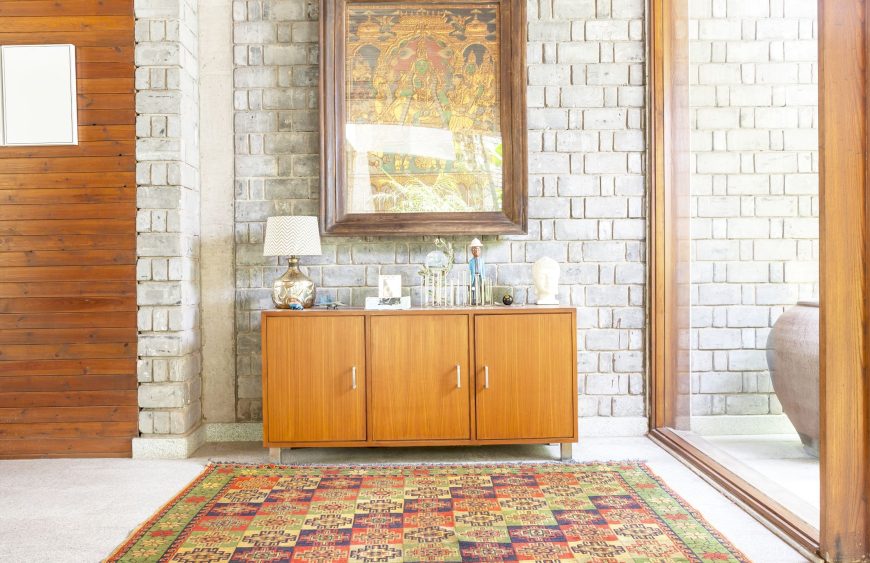
Traditionally woven by nomadic or semi-nomadic people, hand-knotted tribal rugs are among the earliest carpets to have been created. It is believed that the art form may have originated with pastoral nomads in Central Asia who had a ready supply of wool from their sheep. These tribal rugs were used in place of animal pelts for warmth and bedding, with the earliest woollen rugs probably resembling animal pelts with long pile shag.Â
There is little archaeological evidence to accurately pinpoint where and when tribal rugs originated. However, the artistry and design of the world’s oldest known rug, the 5th-century BC Pazyryk carpet, suggests that hand-knotted rugs had been in existence for centuries before its creation.Â
The tribal groups most often associated with handwoven rugs are the Turkmen, the Kurds, the Uzbek, the Belouch and the Qashqai, although there are many others, each with their own weaving traditions. Rather than curvilinear and floral motifs, tribal rugs often feature warm, earthy tones and geometric motifs, as well as incorporating traditional symbols. Most are created using locally sourced wool or cotton and coloured using simple, natural dyes.
Superstitions and folklore in tribal rug designs
While some tribal rug designs are clearly inspired by the surrounding environment, such as plants and animal life, many are abstract and shrouded in mystery. Some motifs were incorporated into designs as talismans and are thought to have protective qualities while others have multi-layered folkloric meanings that can only be interpreted by tribal members.Â
Tribal rugs weren’t always created with a specific design or a colour template in mind, meaning they often reflect the artistic expression of their maker. That being said, traditional design motifs were usually passed down from generation to generation, so there are recognisable traits in the rugs created by different tribal groups.Â
Another distinguishing feature of tribal rugs is that they were not created for commercial trade but rather for personal use. Unlike the complex designs of formal carpets that were graphed onto paper, tribal rug artisans had to memorise motifs. As a result, they tend to be more repetitive in their design. However, you can sometimes see where a weaver has decided to improvise and express their individuality by playing with a particular design element, which adds to the beauty of tribal rugs.Â
It’s worth noting that many of the nomadic groups that we associate with tribal rugs began settling in villages centuries ago, in some cases by force. While some spent the winter in villages and headed to mountain pastures with their flocks in the summer, others were forced to flee their homelands to neighbouring countries or regions.Â
In the wake of this upheaval, some tribal rug weaving traditions were copied by other groups and mass-produced for the commercial market. This was the case with Pakistani Bokhara rugs, which draw on the long-established weaving traditions of the Turkmen, many of whom fled to Afghanistan or Persia following their defeat by the Russian Empire at the Battle of Geok Tepe in 1881.Â
If the fascinating history and mystery of tribal rugs appeal to you, you’ll find plenty of inspiration in our vintage collection at Carpet Cellar.Â